AI for NDT inspection · Aerospace MRO

NDT inspection with a second pair of eyes that never gets tired.

Simmetry applies AI to the six aviation NDT methods: penetrant, magnetic particle, eddy current, ultrasonic, radiography and visual inspection. The model flags indications, the certified inspector decides, and every part is documented.

Book a demo See solutions

Built by NDT inspectors for shops in Latin America and the United States.

SIMMETRY VISIONSAMPLE VIEW
01 02
01 Linear indication · leading edgeTo review
02 Rounded indication · root areaTo review

Final call: certified inspector. Illustrative image, not a real part.

The problem

NDT inspection depends on one person, one instrument and long shifts.

Variability

Two inspectors can read the same part differently. Fatigue at the end of a shift adds to it.

Too few inspectors

Certified NDT personnel are hard to find in Latin America, and training a new one takes years.

Traceability

Many records still live on paper or in loose photos. Finding a part’s history shouldn’t take an afternoon.

Solutions

What we’re building

Three products for the same shop: one to inspect, one to anticipate and one to train people.

In development

Simmetry Vision

AI-assisted detection across all six NDT methods. It analyzes the images and signals from each instrument, flags possible indications and classifies them for the inspector to review.

  • Runs on the shop’s own hardware (edge AI)
  • The inspector keeps the final call
  • Per-part report with image and findings
In development

Simmetry Predict

Predictive maintenance built on inspection history. It finds patterns in findings by part number, engine and component zone.

  • History by part number
  • Trends by component zone
  • Support for replacement planning
Coming soon
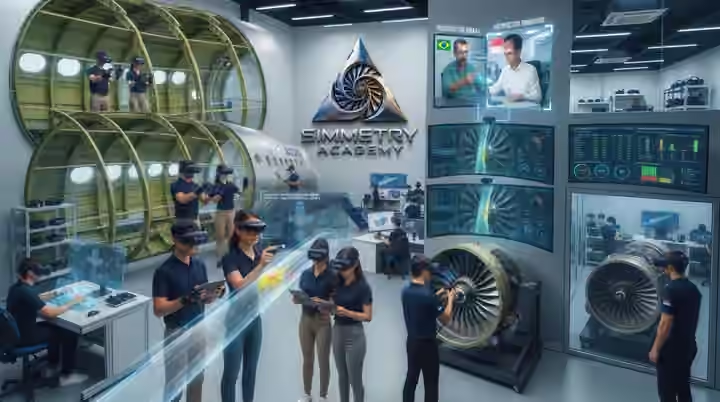
Illustration of a Simmetry Academy lab with students using virtual reality to inspect aircraft engines
Illustrative image

Simmetry Academy

NDT training in Spanish for inspectors preparing for qualification under NAS 410 and EN 4179. Online courses taught by international Level 3 instructors who work in the industry today: aircraft parts manufacturing, MRO, overhaul shops and universities.

Theory moves into the lab. Hands-on practice with real aviation parts and shop procedures, plus virtual reality training to repeat each inspection until it is mastered, before touching a component in service.

  • Level 3 instructors active in the industry
  • Online courses in Spanish for Latin America
  • Lab with real parts and procedures
  • Immersive virtual reality practice
  • AI-adapted path for each student’s progress

NDT methods

Inspection, training and AI across every aviation NDT method.

We perform inspections, train inspectors and apply AI-assisted detection in the six methods used by the aviation industry.

CRACK0.8 mm · 96%BORESCOPE_CAM_02HPT STAGE · BLADE 14/38AI ON
Borescope + AI · VT
LINEAR INDICATION3.2 mm · REJECTROUNDED · OKFPI · UV LIGHT 365 nmSENSITIVITY LEVEL 4
Penetrant + AI · PT
IMPEDANCE PLANELIFT-OFFET · 200 kHz · PENCIL PROBEALUMINUM 2024-T3AI · CLASSIFICATIONSurface crackPhase 112° · 4.1 VEst. depth 0.5 mmConfidence 92%VERTICAL SIGNAL
Eddy current + AI · ET
PTWith AI

Liquid penetrant (FPI)

Reveals surface-breaking discontinuities in non-porous materials. It is the most used method on engine blades, disks and cases.

Inspection · Training · AI

MTWith AI

Magnetic particle

Finds surface and near-surface discontinuities in ferromagnetic materials such as landing gear, shafts and gears.

Inspection · Training · AI

ETWith AI

Eddy current

Detects surface cracks in conductive materials and measures conductivity. Widely used on wheels, fastener holes and aluminum structure.

Inspection · Training · AI

UTWith AI

Ultrasonic

Uses high-frequency waves to find internal defects and measure thickness, in metals and composites.

Inspection · Training · AI

VTWith AI

Visual inspection

The foundation of every inspection. It includes direct visual and borescope inspection inside the engine.

Inspection · Training · AI

RTWith AI

Radiography

Uses X-rays or gamma rays to see inside the part: welds, castings and areas no other method can reach.

Inspection · Training · AI

How it works

AI flags. The inspector decides.

01

Capture

The shop’s instrument records the image or signal (UV lamp, borescope, ultrasonic, eddy current or radiography) using the procedure already in place.

02

Detection

The model flags possible indications and classifies them by type, depending on the method.

03

Decision

The certified inspector reviews each flag and accepts or rejects it. AI does not release parts.

04

Record

A report is saved with image, findings, inspector and date, ready for audit.

Simmetry does not replace personnel qualification or approved procedures. It works within them.

NAS 410EN 4179ASTM E1417OEM procedures

Trends

Where AI in nondestructive testing is heading

Inspection is no longer an isolated event. It is becoming a connected process, with data that builds up part after part.

USD 3.23 BUSD 5.69 B

Global aerospace NDT market, 2026 to 2032. Growing about 9.9% per year.

Source: MarketsandMarkets, April 2026.

01

NDT 4.0

AI, robotics, connected sensors and digital twins working together. Each inspection result feeds a living model of the part or engine.

02

Automatic defect recognition

Deep learning models that classify cracks, porosity and delaminations in ultrasonic, eddy current, radiography and CT. The next step: measuring the defect in 3D and estimating the part’s remaining life.

03

Generative AI and synthetic data

Real defects are rare in aviation, and a model can’t be trained without examples. Generative AI creates realistic defect images to fill in the data. It is already used in radiography and ultrasonic research.

04

Guided inspection

Instruments that tell the inspector what to capture and how, step by step and aligned with the manual. Fewer differences between shifts and a shorter learning curve.

05

What doesn’t change

AI does not replace the inspector. It removes repetitive work and leaves the decision to them. To work, it needs representative data, validation and human oversight.

Where Simmetry fits

All three pieces, in one shop

Simmetry Vision uses synthetic data to train its models and runs on the shop’s hardware. Predict turns inspection history into trends. Academy trains the inspectors who will work with these tools.

News

AI in NDT: what’s happening

Updated: November 2026
Sep 2026 · Nuclear power · ET

DeepEye AI inspects heat exchanger tubes at the Barakah nuclear plant

The Korean startup used eddy current to analyze the condensers and feedwater heaters of all four units in the UAE. Each unit has thousands of tubes. The AI flags abnormal signals and inspectors make the final call.

Read on Seoul Economic Daily
Apr 2026 · Engines · VT

GE Aerospace and Waygate launch AI-guided inspection for GEnx engines

Automated templates on the Mentor Visual iQ+ borescope for the GEnx-1B and GEnx-2B. They guide the inspector through high-pressure turbine blades, with maintenance manual references and 3D measurement.

Read on AviTrader
Jan 2026 · Manufacturing · CT

Avio Aero uses AI to review CT scans of GE9X blades

At its plant in Italy, AI performs a first review of CT scans of 3D-printed low-pressure turbine blades. Certified operators confirm real indications and dismiss false ones.

Read on Avio Aero
Jun 2026 · Research · Multi-method

Argonne unveils SMART-NDI, AI that learns from defect-free parts

The US national laboratory developed a system that learns what a healthy part looks like and flags anything out of the ordinary. It doesn’t need large libraries of labeled defects. It was validated on aerospace applications.

Read on OneStopNDT
Paulina Acosta, founder and CEO of Simmetry Aerospace

Who’s behind it

An NDT inspector and aircraft mechanic passionate about quality systems and aerospace materials.

Paulina Acosta

Founder and CEO

More than 5 years in aviation nondestructive testing. Level II inspector in liquid penetrant, ultrasonic, eddy current and magnetic particle, with experience at Avianca, Avianca Cargo and Aerolínea de Antioquia, where she led the shop’s TAR certification from scratch and served as Authorized Technical Inspector.

She worked as an FPI consultant for GE Aerospace in Taiwan on CF6-80C2 and GEnx engines. Simmetry grew out of that work: knowing where manual inspection fails and what an inspector needs to do it better.

Level II · PT · UT · ET · MTNAS 410EN 4179CF6-80C2GEnx-1B / 2BTPE331

Legal headquarters in Miami, Florida. Operations from Medellín, Colombia. Focused on MRO shops in Colombia, Mexico and Central America.